AI & Innovation: Pioneering the Digital Transformation of Finance at Deutsche Börse Group
Proud to be part of #OneGlobalTeam
Release date: Apr 23, 2026
Artificial intelligence (AI) is rapidly transforming industries worldwide. Deutsche Börse Group is at the forefront, using artificial intelligence to define the future of the capital markets. Across the Group, AI isn't just a buzzword – it's a powerful technology being integrated into daily operations to enhance efficiency, manage risk, and support strategic decision-making. Yet our approach emphasizes that technology must serve people. We spoke with leaders and experts from across our business to discover how the Group navigates the cutting edge of AI, balancing innovation with a human-centric approach.
How is AI transforming daily work and operations at Deutsche Börse Group?
Across our teams, AI is making a tangible contribution to daily tasks, from analyzing complex documents to bolstering our cyber defense. Our teams are leveraging these tools not to replace human expertise, but to augment it, freeing up our employees' capacity for higher-value work.
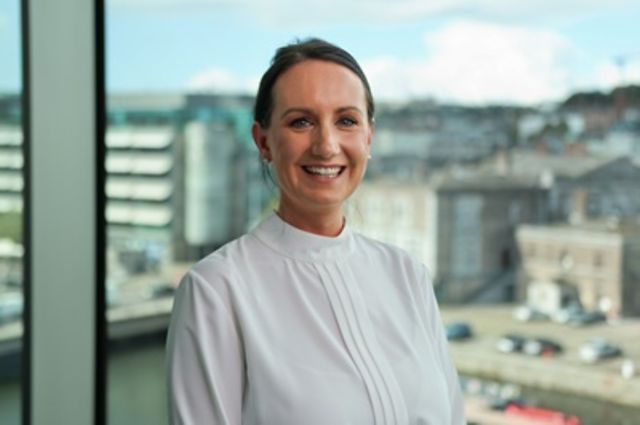
After working abroad for 12 years, Ruth returned to Ireland to lead a client operations team at Clearstream in Cork. She sees the immediate benefits of AI in data analysis. “AI definitely helps us to analyze material a lot quicker and also reduces the error rates” she explains, “we definitely will use it a lot more in the day to day.”
Ruth Barrett, Funds Operations
Ruth Barrett, Funds Operations
Leading five teams responsible for global funds operations, John agrees that automation is a key advantage. He notes that AI “could be a big game changer for our business in terms of creating greater efficiency and taking away a lot of the manual work.” He adds that this shift allows employees to take on more strategic roles “and in doing so the people who currently do that work today, can be assigned to more value-added tasks, so we can provide clients with the best service we can.”
In cybersecurity, AI is a critical component of our defense strategy. Jeremy, who works in cyber protection, details AI’s role in proactive threat management: “our technology is embedding AI to do protection and defense. It is used for pattern matching and monitoring different threats. And it is helping us to prioritize and remediate those threats.”
Nataliia, who leads a security team, agrees that AI can be seen as a force multiplier for threat detection. “AI is an extreme and new technology which can support threat detection and anomaly detection,” she notes, “it can do things in a second which humans would never be able to do. So, for us, AI supports a lot in analyzing all the potential risk factors and in reducing them.”
What are the opportunities and challenges of integrating new technologies, and how does the Group maintain a human-centric approach?
While the opportunities are vast, our experts recognize that integrating advanced technology comes with challenges – from managing new risks to ensuring that innovation empowers, rather than replacing our people. The consensus is clear: technology is a tool, and its ultimate success depends on the humans who wield it.
Adam Graf, Functional Analyst
Adam Graf, Functional Analyst
Adam, a Functional Analyst, views the current technological shift as a thrilling opportunity for innovation. He finds it “really exciting to work on the many projects, especially in this era when we are migrating from the legacy technologies and legacy systems to a new way of doing things.”
Based in Prague, Aleksandra leads several teams responsible for opening securities on international markets. She views this evolution as an opportunity for employee growth. “People were not only coming and wanting to test automations, but they wanted to do more than regular business activities. They also got other colleagues excited about it. So, this is where the change starts to happen for me as a leader.”
This human-centric view is echoed by Nataliia, who emphasizes balance. “We are following the principle of cutting-edge technologies, but in the right balance with a human centric approach” she explains, “meaning that technologies are there to support and to provide security, but they are executed and created by humans.”
Ultimately, client relationships remain paramount. Ruth highlights that technology will not replace the value of human connection. “I don't see us losing the human aspect that makes Clearstream so special” she states firmly, “if our clients want to call us, they don't want to speak to an automated system. They want a human response.”
This forward-thinking approach also requires anticipating new challenges. Jeremy points out the dual nature of AI in the security landscape: “I would imagine that now attackers are also using AI because if we have the possibility to use AI to defend ourselves, I'm pretty sure that they will use the same to attack us.”
In essence, Deutsche Börse Group is embracing AI not as a replacement for human ingenuity, but as a powerful enabler for the future of finance. By focusing on smart integration, continuous learning, and an unwavering human-centric approach, we are driving efficiency, enhancing security, and empowering our people. This strategic balance ensures that technological advancements serve to strengthen our role as true engineers of the capital markets, building a more resilient and innovative financial ecosystem for everyone.