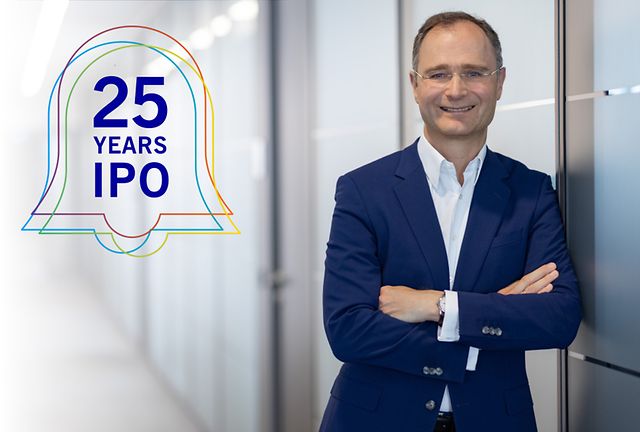
A conversation with Stephan Leithner about responsibility, innovation, and the legacy of the IPO.
Twenty-five years ago, on February 5, 2001, Deutsche Börse Group went public. This was a symbolic and, above all, courageous step. A quarter of a century later, the company embodies stability, dependability, and innovative spirit. Its role in the global financial markets extends far beyond Frankfurt.
Mr. Leithner, on February 5, 2001, Deutsche Börse Group listed itself on the stock exchange. Do you remember what you were doing that day?
In those days, I was an investment banker and was working on several projects with Deutsche Börse Group. But when the bell rang, I was not on the trading floor myself.
What was your opinion of the IPO at the time?
It was certainly a very significant moment. The dismantling of Deutschland AG was well underway at the time, and Deutsche Börse Group was still, in a lot of ways, a remnant of that old structure. At the same time, however, it had long since demonstrated its ambition for growth, change, and innovation. It was, in a sense, trapped in a shell that had become too small for its own ambitions. The IPO changed that and unleashed enormous entrepreneurial energy; it was unmistakable.
The IPO coincided with a period of uncertainty – the dot-com bubble had just burst. Why was this particular moment the right time?
Taking the step onto the capital market was not a spontaneous, reactive idea, but one that had been planned and developed over many years. I was involved in the first projects to develop an equity story as far back as mid-1999, when I was still working as a consultant for Deutsche Börse Group. As I said, the shell that Deutsche Börse Group was in at the time had become too small, and management had exhausted every conceivable option for growth. To pursue more ambitious goals, such as a takeover of the London Stock Exchange, what was needed now was more flexibility and, ultimately, greater financial strength.
The IPO delivered both. Are there principles from that time that are still part of Deutsche Börse Group’s DNA today?
Absolutely! Firstly, there is the focus on innovation. Back then, we were the first exchange worldwide to switch to electronic cash market and derivatives trading. Secondly, the entrepreneurial spirit: Deutsche Börse Group started out as a sleepy, local cash market player and, within just a few years, transformed itself into a rapidly expanding global player that wanted to cover the entire value chain on the capital markets – and succeeded in doing so. And lastly, the special sense of responsibility towards Frankfurt and all the stakeholders who were closely involved in the IPO. The company continues to be defined by three core values: a commitment to innovation, entrepreneurship, and responsibility.
You mentioned the entrepreneurial drive to shape outcomes. What were the key turning points in that respect?
The first was undoubtedly the development of our fully integrated business model by 2005, both in post-trading with Clearstream and in the derivatives sector. This was unique in Europe and an important building block for future success. This was followed, until 2015, by a long and painful period that ultimately led to the realization that bold political initiatives alone were not enough – all the relevant stakeholders had to be brought on board. The period was marked by intense confrontations with financial investors and a series of merger attempts, none of which came to fruition. What I find striking is that, alongside these major initiatives, entirely new core business pillars took shape – including the fund business, the 360T foreign-exchange platform and the energy exchange in Leipzig. Today, our company is structured around eight business areas, three of which did not exist in 2005.
What role has technology played along the way?
Technology shapes our business activities. Almost no other industry is as quick to adapt to innovation as the financial markets. Our aim is to spearhead these developments while always keeping the market on board. It is not enough for us to invent things on our own. For us, innovation is only successful if we manage to get everyone on board.
Timing is everything. Take the cloud, for example. When we began to engage intensively with this topic in 2018, neither regulators nor other market participants shared our enthusiasm. The key to success was to form a Cloud Audit Group, lead it, and build trust. There is little point in building a modern-day Neuschwanstein if no one is prepared to move in.
One thing that has changed even more than technology is geopolitics. You often describe Deutsche Börse Group as a safe harbor. Continuing with that metaphor, what have been the biggest storms testing its defenses?
One huge issue, of course, is how global markets are now shifting in a truly fundamental way. We are witnessing a tectonic shift that we need to find answers to. What is interesting is that the demand for security and trust surges in such times. That is exactly the need we cater to with our products and systems. We build infrastructures that keep values secure and prevent them from being lost.
Europe, too, is having to reorient itself in this world. What role does the capital market play in the European project?
As far as Germany is concerned, I have been saying for some time that the capital market must play the same role for Agenda 2030 as the labor market played for Agenda 2010. For Europe, that is even more true. The issue of financial self-sufficiency takes on an entirely different dimension at the European level.
Does Europe therefore need a kind of watershed moment in capital-markets policy?
I would be more inclined to say that we need to rethink our mindset! We don’t need a top-down directive; we need widespread change. Ultimately, the difference between the US and Germany is not that a few smart minds on Wall Street make particularly clever decisions, but that 200 million people in the US participate in in capital market wealth creation every day. Trust is vital for this. And that is what we have to advocate for here.
You mentioned that there’s €33 billion in unused capital in Europe. How do you plan to mobilize that?
I see three major levers here. First, we need personal incentives to encourage market-funded retirement saving, such as tax-efficient investment accounts. Second, we need to establish employer-subsidized workplace and social-partnership models based on the Swedish model. Third, we need to get institutional investors such as pension funds to invest more productively; a large proportion of the money is dormant there as well.
What else needs to change in order to motivate more companies to go public again?
We urgently need to tackle the one-sided burden on listed companies – in reporting, for instance. This has reached a level that has a strong deterrent effect. It would likewise be beneficial not to discourage existing private owners with negative tax implications if a company were to go public.
So with all that said, would you still list Deutsche Börse Group in Frankfurt today?
Absolutely! Nowhere else would we have this visibility and this sense of belonging. These are two aspects that tend to be greatly underestimated. No European company today is large enough to be listed on a relevant US index, while Deutsche Börse Group, with a market capitalization of €40 billion, is one of the leading DAX companies. This visibility is crucial for how investors value us. And of course, Frankfurt’s trading floor is also a kind of emotional home for us.
How do you preserve this Frankfurt identity while maintaining a global presence?
A large part of our identity can certainly be traced back to precisely this historical and symbolic nucleus, specifically the Frankfurt trading floor. The trading floor is part of us; we maintain it, and we continue to use it very intensively. That said, having a strong sense of belonging also means that we are very actively involved in our local community, be it in the social sector, in education and research, or in politics. What matters is the holistic nature of that sense of belonging.
Are there any key figures who have had a particular influence on the development of this identity and culture?
I believe there have been many different people who have left their mark on Deutsche Börse Group over the past 25 years and made this organization what it is today. It is precisely this variety that defines the company.
What kind of business leader would you say you are?
I am relatively rational by nature, but deeply anchored in values. I act on conviction. And I work in a very team-oriented way.
How do you square rationality with conviction?
My convictions are guided by core principles: a belief in a shared European capital market, honest entrepreneurship, and teamwork.
What is your impression of the next generation of entrepreneurs?
What I see in our offices in Eschborn, in the elevator and at meetings, is enormous diversity and variety, coupled with a desire not to spend too much time talking things over, but to move them forward. We don’t just intend over here – we take action.
As we bring this to a close, let us look ahead: what role should Deutsche Börse Group play in the global financial landscape in the coming years?
What matters most is that we continue to be more than just a company. We must act based on our principles and not merely pursue the development of capital markets out of commercial interest. Only if we accomplish this we will be able to take customers, regulators, and politicians with us on our journey; only then will we be successful overall. Plus, we need to hold onto our innovative drive. It is unlikely that any other sector will undergo as much change in the coming years as the financial industry.
How would you like to be remembered personally?
I want the Deutsche Börse Group to be seen for what it has long been: a European champion that is loved, respected, and valued. I want to anchor this European identity across the entire company. And I want to ensure that we emerge from the profound transformation ahead of the financial markets as a global leader.